EN

Why Brass Jewelry Turns Skin Green - and How We Prevent It
2026/09/23
Discover why brass jewelry can cause green marks on skin and how AURAE prevents this issue effectively.
Electroplating is the reason a brass ring can look like 18K gold, a silver pendant can stay bright for years, and a white-metal band can be worn by someone with sensitive skin. It is also the part of jewellery manufacturing that clients understand least - and the part that decides whether a piece still looks new after two years of daily wear. This article explains how plating actually works, what separates a good plating line from a cheap one, and how to specify plating correctly when you place a custom order.
Plating deposits a thin layer of metal onto a base material. Done properly it does four things at once: it raises corrosion resistance, increases surface hardness, resists wear, and delivers the final colour and gloss. In some technical applications the same process also improves conductivity, lubricity and heat resistance, but in jewellery the priorities are colour, durability and skin contact. The base material provides the strength and the shape; the plating provides the appearance and the protection.
Water plating, also called electrolytic plating, uses the metal to be deposited as the anode and the jewellery as the cathode, so metal ions are reduced onto the surface and form the coating. It is the workhorse process for gold, rhodium, palladium and silver tones and it is compatible with almost every jewellery construction. Vacuum plating, or PVD, deposits the coating in a vacuum chamber; it is noticeably more wear-resistant, which is why it is popular for high-wear rings and watch hardware. There is one rule clients should know before specifying it: jewellery set with stones cannot go through vacuum plating. If a design carries gems, water plating is the correct route, and the durability comes from layer design rather than from the deposition method.
A durable finish is never a single layer. A professional build looks like this: a thoroughly polished and cleaned base material, a silver plating layer to level and brighten the surface, a palladium plating layer that acts as a barrier against tarnish and diffusion, a colour plating layer that sets the final tone, and a nano protection layer on top that shields the colour layer from sweat, cosmetics and abrasion. Each layer has one job, and skipping any of them shows up later as a colour shift, a patchy highlight, or plating that flakes at the edges where wear is highest.
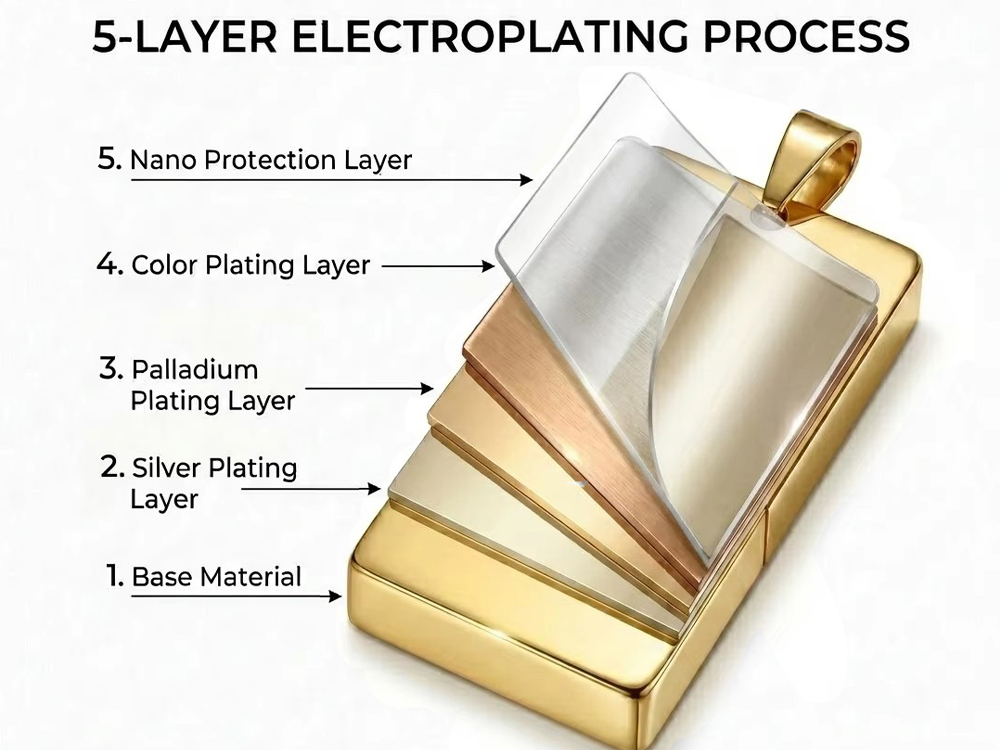
White finishes come from white steel or rhodium plating - rhodium being the platinum-group metal most clients call "white gold plating". Gold tones are produced in 18K and 24K colour baths, which is why the same base ring can be finished in a warm, saturated gold or a paler champagne tone. Rose gold is built from a gold bath with copper salts, and the ratio determines how pink the result reads. Two-tone pieces - a white band with a gold edge, for example - are plated twice: the first colour is applied, the parts that must stay that colour are masked with a protective oil, and the second bath finishes the rest. Every one of these routes normally requires a base plating before the colour layer, and that base is what stops the colour from drifting.
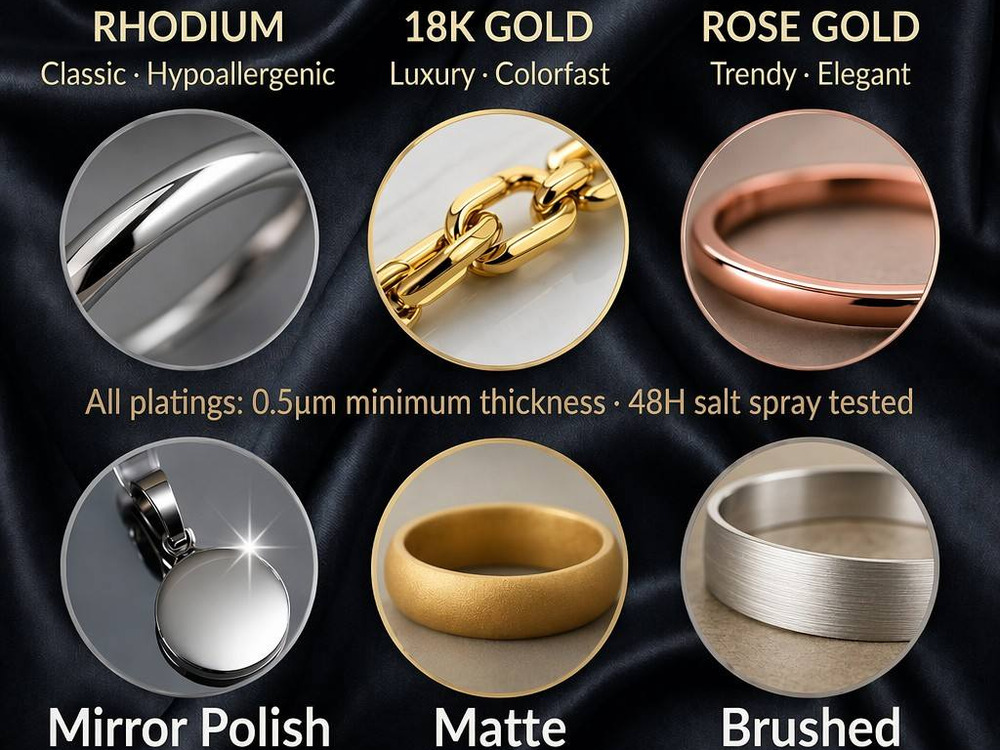
Plating quality is decided by parameters that are invisible on the invoice. Immersion time is typically held to a window of about 25 to 30 seconds per stage, and decorative plating thickness for jewellery commonly falls between 0.25 and 0.5 microns. Thin, fast plating saves cost and wears through quickly; heavy, badly bonded plating cracks. Our standard is a minimum 0.5 micron and 48-hour salt spray testing, with layer thickness verified by SEM cross-section inspection rather than assumed from the process sheet. If a supplier cannot tell you the thickness of the colour layer in microns, they cannot guarantee the colour for a season, let alone a warranty period.
Almost every premature plating failure traces back to one of four causes. The first is preparation: polishing residue, oils or oxide left on the surface before plating prevents proper adhesion. The second is a missing or too-thin barrier layer, which lets the base metal migrate into the colour layer and dull it. The third is insufficient colour thickness on edges and corners, which is where wear always starts. The fourth is abrasion damage from cosmetics, cleaning agents and chlorine, which attacks the top layer long before the metal underneath is affected. A plating line that controls preparation and layer thickness solves the majority of complaints before they happen.
Rhodium plating is the classic hypoallergenic option and remains our default recommendation for clients who react to base metals, because it forms a dense, inert surface that keeps skin away from the alloy underneath. Palladium is used in the same spirit inside the stack, as a barrier layer between the base metal and the colour plating. Where a design uses brass or copper, the barrier and protection layers matter even more, since copper is the metal most likely to react with sweat and leave marks - a topic we cover in detail in our article on brass and copper anti-tarnish technology. Surface finish also plays a role: a mirror-polished surface has fewer micro-pockets to trap residue, while matte and brushed finishes should be cleaned more often.
Every plated piece passes a 20-point final inspection that includes sizing and weight checks, hallmark verification under 10x magnification, structural function tests on clasps and hinges, stone security testing with a microscope probe and a zero-snag silk test, and a surface check that requires zero scratches, no water marks, uniform texture and flawless plating boundaries. Plating is inspected under 10x magnification, not by eye. Pieces that fail go back to be stripped and re-plated rather than shipped with a note.
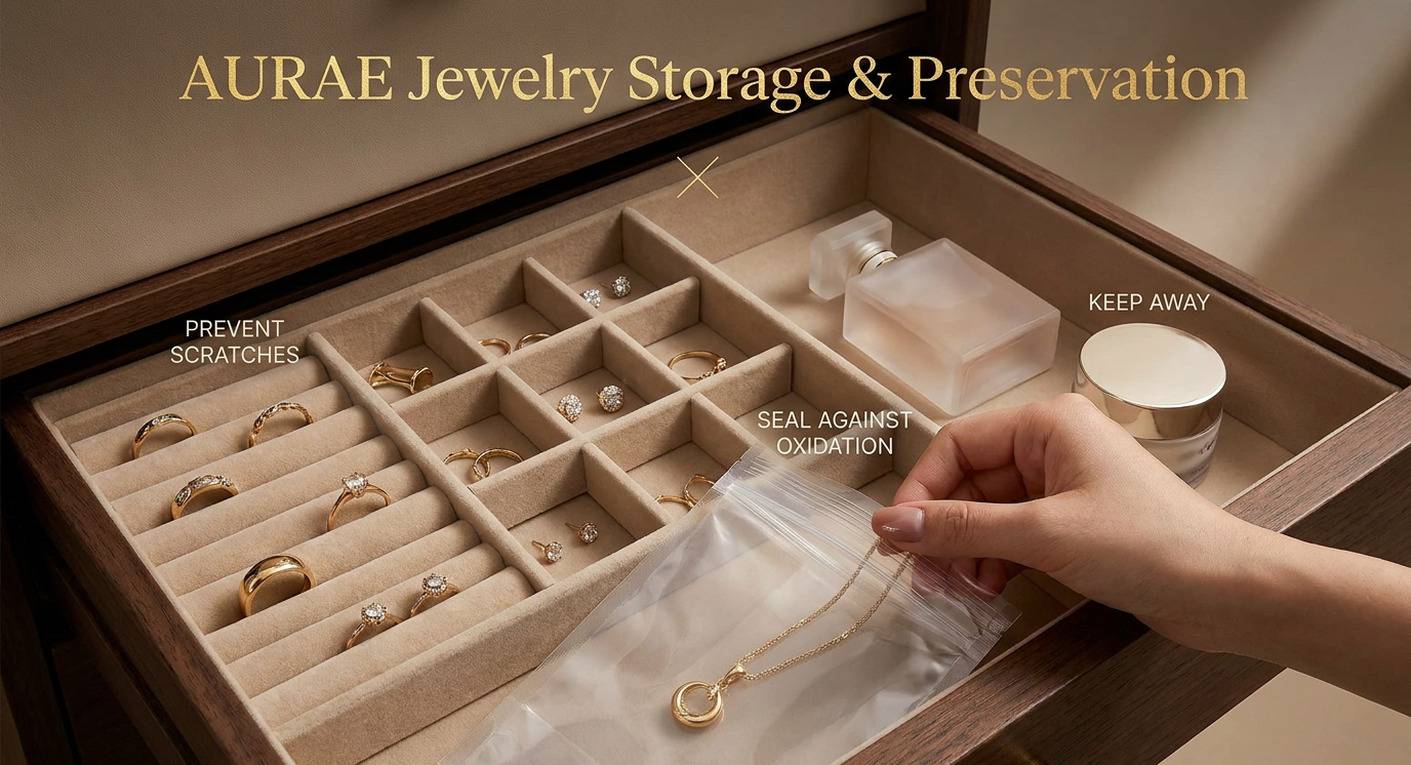
The same care rules apply to every plated piece. Wear jewellery last when getting ready and remove it first at the end of the day. Keep it away from perfume, lotion, hairspray and cleaning agents, all of which can attack the top layer. Remove rings and chains before swimming, bathing or training, and store each piece in its own velvet-lined compartment or a sealed pouch so metal does not rub against metal. Clean with a soft dry cloth rather than an abrasive polish, and give plated pieces a wipe after wear; that single habit is what keeps a 0.5 micron colour layer looking new.
If you are planning a collection and need the finish to survive retail handling, wear testing and repeat customers, send us the design and the wear scenario. We will recommend the plating route - water or vacuum, single or multi-layer - the colour bath, and the thickness standard that matches how the piece will actually be worn.
2026/09/23
Discover why brass jewelry can cause green marks on skin and how AURAE prevents this issue effectively.
2026/09/18
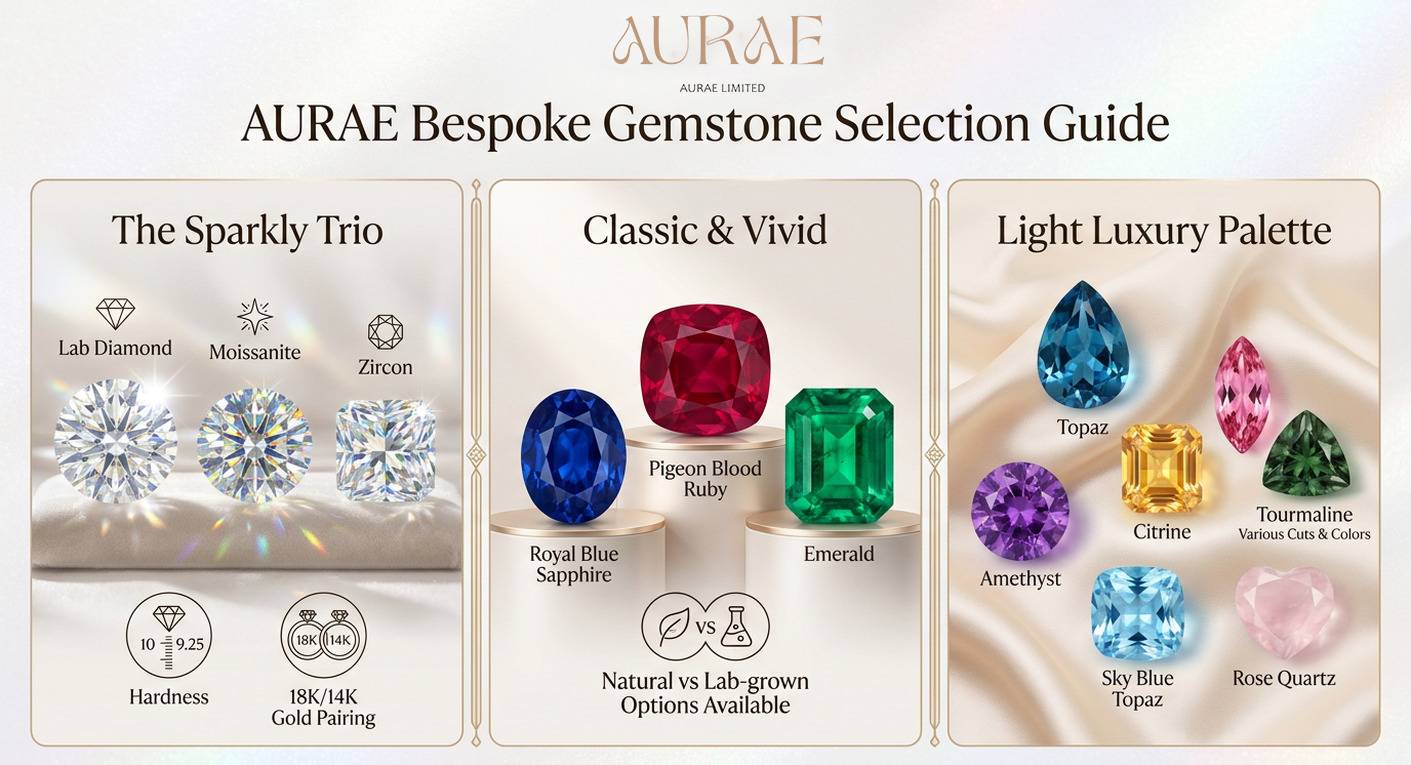
Discover tips for selecting the perfect gemstones for your custom jewelry at AURAE. Make informed choices for stunning designs.
Bespoke know-how from our studio and factory floor: how we choose gemstones, build plating that lasts, and keep brass jewellery from turning skin green.
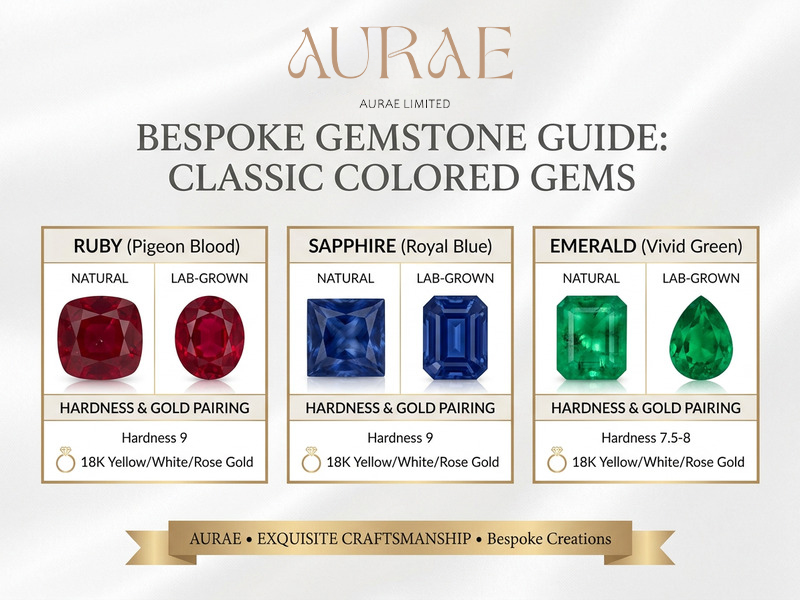
Hardness, colour and setting decide how a bespoke piece looks and wears. Our guide pairs lab diamond, moissanite, zircon, ruby, sapphire and emerald with a matching gold tone and a protective setting.
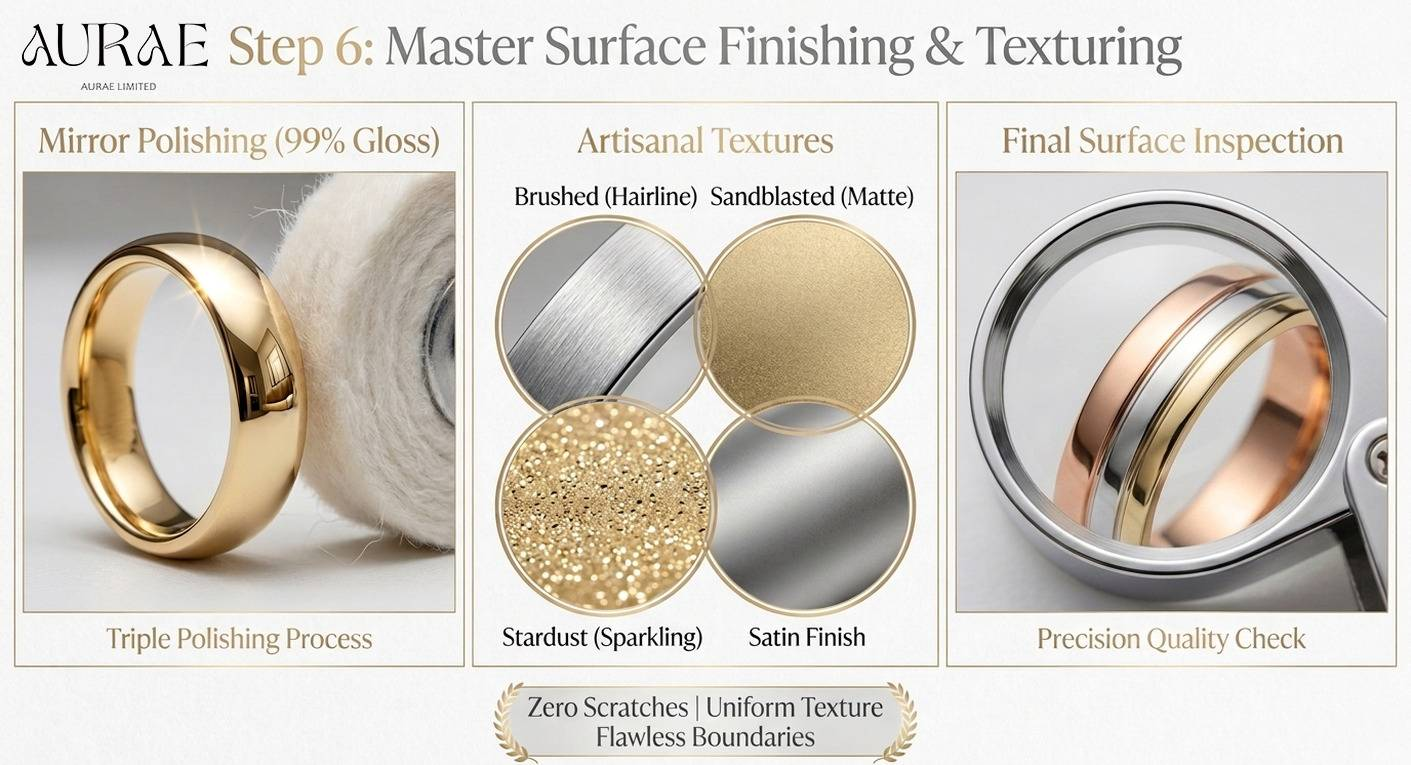
What happens between polishing and packing decides whether a finish lasts: water versus vacuum plating, the five-layer stack, white, gold and rose colour baths, and our salt-spray standard.
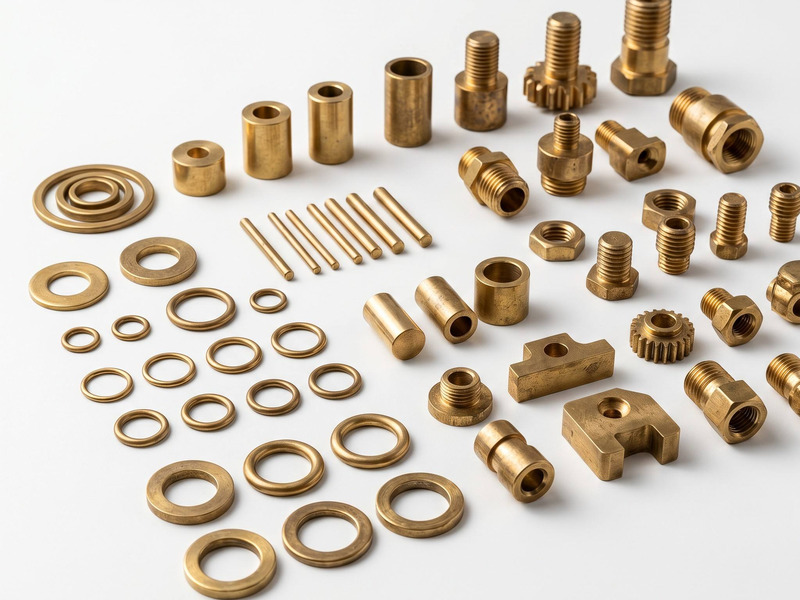
Green marks come from brass meeting sweat - and they can be engineered out. Our championship-ring brass formula keeps skin clean even when plating wears through.